A Cybersecurity Awareness Month message from the Sudo Safe Initiative
Most cybercriminals aren’t breaking down doors. They’re walking through the ones we leave open.
Every October, Cybersecurity Awareness Month reminds us that digital safety isn’t only the job of IT teams and security professionals. It belongs to all of us. This year’s theme, “Don’t Make It Easy for Them,” puts it plainly: the easier we make it, the more often they get in.
And one of the widest open doors in most people’s lives is how we communicate.
Your phone number and email are more than contact details
Think about how often you hand out your personal phone number or primary email address:
- Signing up for a store loyalty program
- Downloading a coupon
- Listing something on a marketplace
- Booking a haircut
- Registering for a webinar
Each time, that information lands in another database. Some of those databases get sold, shared, or breached.
Over time, your phone number and email become the thread that ties your whole life together: your bank, your healthcare portal, your social accounts, your family, your work.
Criminals understand this. With your personal number and email, they have what they need to:
- Send convincing phishing texts
- Impersonate your bank or employer
- Attempt account takeovers
- Run SIM-swap schemes
- Build a detailed profile of who you are and who you trust
We’re handing them the starting point. That’s making it easy.
5 habits of safe communication
The Sudo Safe Initiative talks a lot about building simple, repeatable habits, because good security must be practical enough to survive a busy Tuesday. When it comes to communication, these five make a real difference.
- Separate your identities. Your closest relationships and most sensitive accounts deserve a phone number and email that aren’t floating around on a hundred sign-up forms. Use different contact details for shopping, dating, selling online, volunteering, and work.
- Choose encryption wherever possible. If a conversation matters, it should be protected end to end, so only the people in it can read it.
- Slow down before you respond. Scammers rely on urgency. An unexpected text about a package, a frozen account, or a “quick favor” from your boss is a cue to pause and verify through a channel you already trust.
- Know your exposure. You can’t protect what you can’t see. Understanding where your personal information already lives online helps you decide what to change first.
- Share less by default. Before you give out your number or email, ask whether the person or company on the other end really needs it.
How MySudo helps you close the door
These principles are exactly why Anonyome Labs built MySudo. The idea is simple: you should get to choose what information you share, with whom, and when.
One app, up to nine separate identities
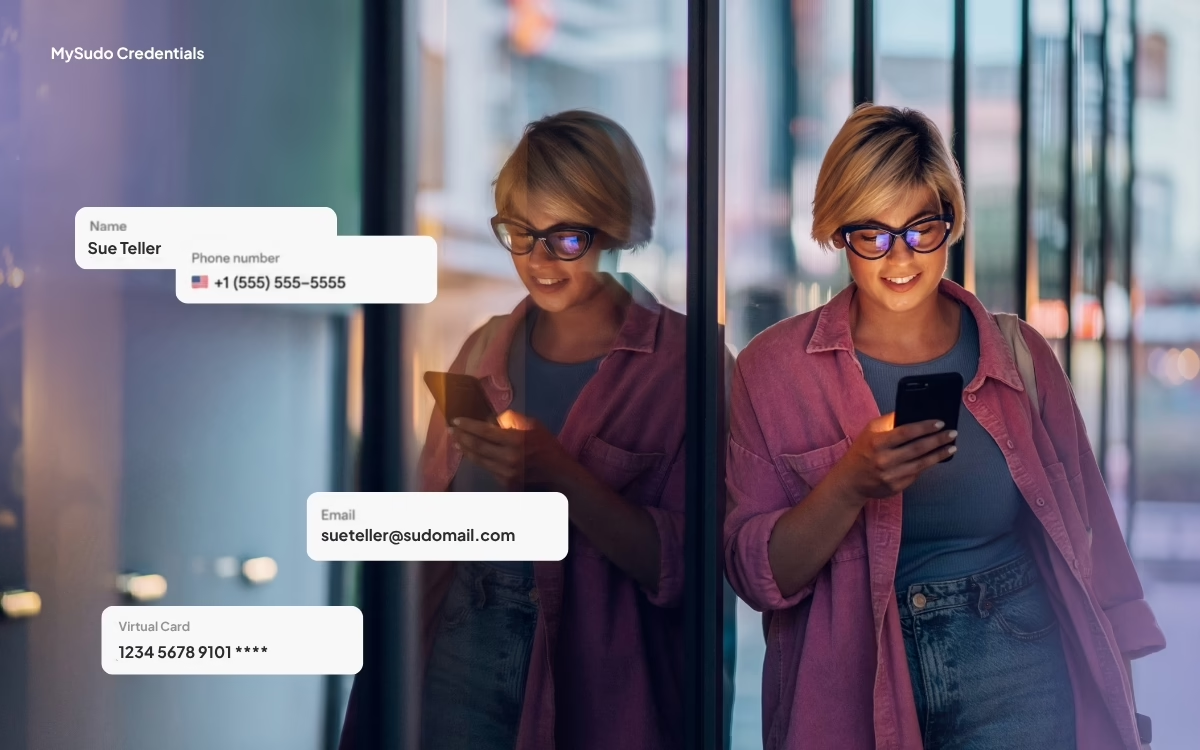
With MySudo, you can create up to nine separate “Sudos.” Each Sudo is its own digital identity, with its own credentials:
- A phone number
- An email address
- A virtual card
- A secure communications handle
- A private browser
Use each Sudo for a different purpose: one for online shopping, another for selling on marketplaces, another for dating, another for volunteer work. Your personal number and email stay private, reserved for the people and accounts that truly need them.
If one Sudo starts attracting spam or suspicious messages, it’s contained, and it never leads back to the real you.
Encrypted conversations, no phone number required
Communication between MySudo users is end-to-end encrypted. Sudo Handles let you call, video chat, and message other MySudo users without revealing a phone number at all.
Handles don’t require a paid subscription, which makes private, encrypted conversation accessible to anyone.
Privacy built in from the first moment
- MySudo doesn’t require personal information to get started.
- Encryption keys are generated on your device when you first open the app.
- Anonyome Labs does not sell personal information.
Our business is providing privacy tools, not monetizing your data.
Beyond communication: the MySudo Suite
Safe communication is essential, but it’s only one piece of staying safer online. Protecting your data, your payments, your connection, and your logins matters just as much. That’s why the MySudo Suite goes further:
- Free data exposure scan: see how much of your information is already out there.
- Virtual cards: help protect your payment details.
- MySudo VPN: encrypt your internet connection on any network, including that coffee shop Wi-Fi.
- MySudo Password (coming soon): manage your sudo credentials and keep your logins strong, unique, and protected, so one breached password doesn’t open the door to everything else.
Don’t make it easy for them
Cybercriminals count on convenience: ours, not theirs. They’re betting we’ll reuse the same number everywhere, click before we think, and never check what’s been exposed.
Every step we take to separate, encrypt, and protect our communication makes their job harder and our lives safer.
Your one-step challenge this October
Look at where your personal phone number and email are being used, and ask whether they need to be there. If they don’t, swap them out for Sudo details to stay more secure.
Then share this post with someone you care about, especially the family members and friends who are most often targeted.
Want to see where you stand? Download MySudo and start with our free exposure scan right in our app, and become a Sudo Safe Advocate for practical tips on staying safer online.
Let’s make it harder for them, together.